
As seen in ECO Magazine, September 2018
Written by Rose Fisher and Kira Coley
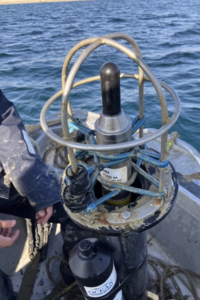
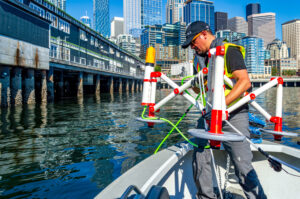
Yellow buoys bob in the chilly water of a fjord near Canada’s St. Lawrence Estuary. As the buoys silently drift through the stratified currents, an onlooker will likely have no idea about the symphony of sound playing out under the water’s surface. Digital hydrophone arrays attached to the buoys’ bases are collecting sound data, capturing the ocean soundscape, searching for and studying the endangered beluga whale.
Marine Mammals of the St. Lawrence Estuary
Canada’s east coast is home to some of the best whale-watching sites in the world. Every spring, thousands of whales leave the Atlantic Ocean and enter the St. Lawrence Estuary. Teeming with fish and plankton, the estuary is the summer feeding ground for up to thirteen different whale species, the more frequent of which include the blue, fin, humpback, and minke whales, and the resident beluga.
These whale species are regularly seen in the estuary from May to November, explains Clément Chion, Associate Professor in the Department of Natural Sciences at the University of Quebec in Outaouais (UQO).
“But among these top five, under the Species at Risk Act in Canada, the beluga and blue whale have an endangered status and the fin whale is of special concern.”
Clément is part of the Maritime Transportation and Marine Mammal Protection working group, formed in 2011, which is exploring solutions to help mitigate the risks of shipping on marine mammals.
The Impact of Marine Traffic
In addition to its rich biodiversity, the St. Lawrence Estuary is a major seaway linking the Atlantic Ocean to the Great Lakes. Each year, merchant ships conduct more than 7,000 transits through the estuary, in addition to thousands of trips by whale-watching boats, ferries, and pleasure craft.
“The resulting co-occurrences between boats and whales have raised concerns about negative impacts, including both collisions and exposure to underwater noise,” adds Clément.
Ship traffic around the world has increased at an accelerated pace and shows no signs of slowing down. As Arctic ice continues to melt, shipping channels are opening, placing previously undisturbed species at risk of vessel strikes, communication and navigation challenges caused by noise pollution, and other threats introduced by human activity.
Read the Full Article
This article originally appeared in the September 2018 issue of ECO Magazine. Read the full article in ECO Magazine.